They can never make diversity a dirty word
It’s hard to think of a single day in the past two years when the word ‘diversity’ hasn’t been used as a weapon in the ongoing culture wars. Elon Musk’s…
Meena Alexander · May 23, 2026 · 4 min
It’s hard to think of a single day in the past two years when the word ‘diversity’ hasn’t been used as a weapon in the ongoing culture wars. Elon Musk’s week-long rant about Lupita Nyong’o playing Helen of Troy in the upcoming Christopher Nolan film The Odyssey is just one bizarre example. (In case you missed it, Musk claimed that Nolan had “desecrated” the ancient Greek epic by casting a Black woman as the most beautiful woman in the world to play into the Academy’s “DEI lies”.)
Identity politics is dominating on both sides of the Atlantic. Since day one of his term, the US president has made it his mission to slash diversity, equity and inclusion (DEI) measures across the private and public sectors, arguing that they are discriminatory against white Americans. Month by month, policies put in place to rebalance the systemic inequalities that hold marginalised people back are disappearing. Nevermind the fact that countless studies prove the positive impact of DEI – for everyone, including the white men who may be grossly underrepresented in universities without it. But this, like so much of the political conversation right now, isn’t about facts. It’s about feelings.
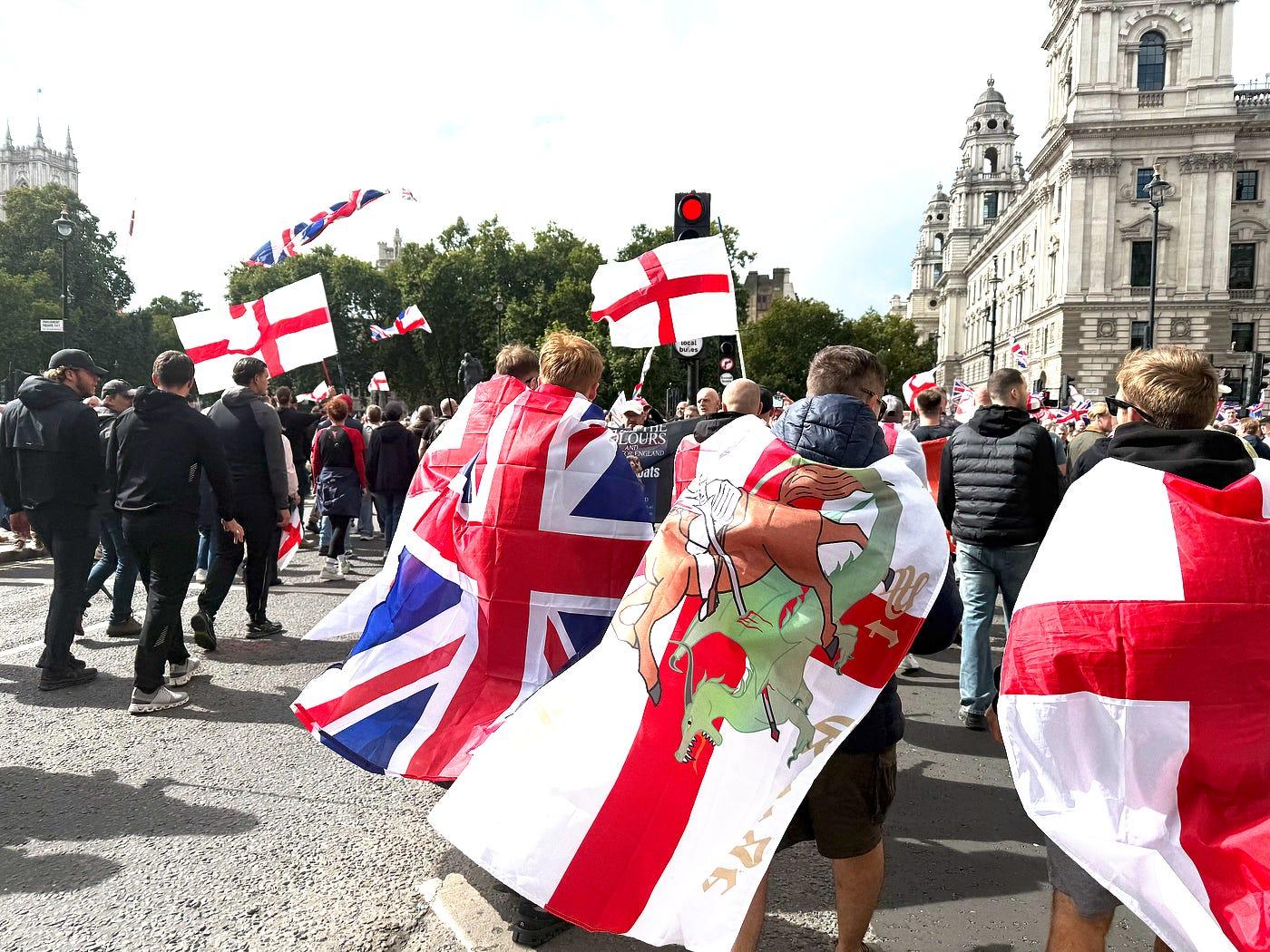
The feelings fuelling the Trump administration’s DEI warfare aren’t so different from those expressed on the streets and in the polling stations of the UK over the past few weeks. The wave of Reform wins in local elections show just how many people back a party built on anti-immigrant sentiment and Islamophobia (which has already seen several councillors resign due to racist remarks). Then there’s the high-profile story of a white woman suing the positive action group 1,000 Interns Foundation for not offering her an internship. And the so-called Unite the Kingdom rally led by far-right firebrand Stephen Yaxley-Lennon aka Tommy Robinson, which appeared to succeed only in uniting 20,000 people with a penchant for racial and religious hatred.
In the end, it comes down to white grievance. The attack on diversity is led by people whose privilege has long gone unchallenged, throwing their toys out of the pram rather than sharing some with the rest of us. Once a harmless word that simply meant ‘variety’, now powerful people fling it like mud to show their disdain for anyone who is not like them – or who dares to believe that meritocracy is a myth in an unfair world, and that we all deserve a seat at the table. And unless we reclaim it, we’re on a slippery slope towards deeper inequality.
The unfashionable fact is this: nothing strengthens a country more than a diverse mix of lived experiences. If money is all that matters, as certain world leaders would have us believe, then the hostility towards DEI makes even less sense. A 2020 report by McKinsey analysing 1,000 US businesses echoed what so much research has found before: firms with greater diversity consistently outperform their peers, with ethnic diversity in particular accounting for a 36% probability of higher profits.
The financial benefits of embracing immigrant communities are also widespread, from the billions of dollars that graduate visa holders – who now face a $100,000 entry fee and a higher salary cap to contend with – pour into the US economy to the fact that immigrants launch new companies at twice the rate of native-born Americans. In fact, 45% of Fortune 500 companies were founded by immigrants and their children. We see the same economic boost across Europe and especially in the UK. It’s well-known, too, that the NHS and social care system simply would not function without foreign-born workers: 1 in 5 staff are non-British nationals, not to mention the children and grandchildren of people who moved here to build something new.
This building spirit is so often present in ethnic households. There can be an outsized pressure to succeed; to prioritise education and a lucrative career that will offer stability. This goes some way to explaining the presence of immigrants at the top of every field in the UK and the US, but it’s not because of the individualistic meritocracy that conservatives cling to – it’s in spite of it. To overcome the systemic racism and gender bias that’s baked into our societies, we must be doubly excellent at what we do.
That excellence shouldn’t be a prerequisite to celebrating diversity, but it has certainly given us great gifts. It’s the music and literature and art that opens our minds to different ways of being. It’s the flourishing global food scene; flavours that allow us to travel to Italy, India, Japan and Mexico all in the space of a day. It’s in cities like London and New York and LA, made vibrant by the intermingling of global languages, styles and ideas.
There is a mutual appreciation and care that exists, and has always existed, in diverse communities around the world, despite the division our social media feeds would like us to hyperfixate on. The concept of diversity may be under siege right now, but it can never become a dirty word. We must dust it off, protect it and remember just how rich – in every sense of the word – our differences have always made us.
More like this

A Nation You Can Carry
Haiti returned to the World Cup after 52 years - without a home, and now without the right to wear its own history. So it brought the one thing no committee…
Jonathan Giles · 5 min

I Love Boosters, Boots Riley, and the Battle of Black Art at the Box Office
Despite their impact, nearly all culturally specific, Black-directed films are produced with budgets below $40 million, but are still expected to compete with…
Xero Gravity · 6 min
Megan Thee Stallion: The Consequences of Being A Sexual Black Woman
After the death of her parents, grandparents, and the shooting by Tory Lanez, Megan Thee Stallion was facing one battle after another. For many Black women,…
Habiba Katsha · 5 min