A Nation You Can Carry
Haiti returned to the World Cup after 52 years - without a home, and now without the right to wear its own history. So it brought the one thing no committee…
Jonathan Giles · June 26, 2026 · 5 min
Haiti returned to the World Cup after 52 years - without a home, and now without the right to wear its own history. So it brought the one thing no committee can confiscate.
The night Haiti qualified, the sound got there first.
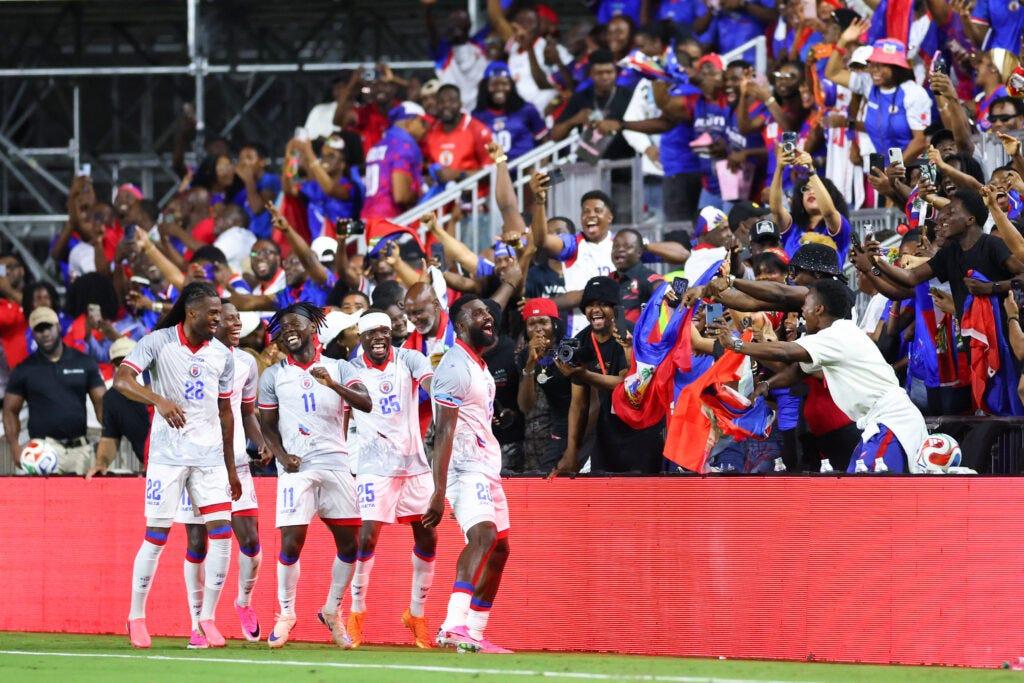
Before seeding, before anyone in a studio could explain what had happened, the Konpa was already in the street. Port-au-Prince, Brooklyn, Little Haiti, all across the communities where Haitians lived, the rara horns went up, the rabòday dropped, and people who’d spent the better part of five years watching their country come apart on the evening news danced. They danced as if the news had finally broken the other way.
Then it slowly hit us: Haiti had reached the 2026 World Cup, its first since 1974, without playing a single home game. Not a single one. No team in the history of the tournament had ever pulled that off.
One would call that a feat. Yet, it also felt like a sentence.
As stated multiple times during the World Cup, the Haitian team hadn’t hosted a competitive home match since June 2021, when Canada won in Port-au-Prince. Weeks later, the president was assassinated, and then the floor fell out. In March 2024, armed gangs overran Stade Sylvio Cator, the 15,000-seat ground that had been the national team’s home since the 1950s. Shortly after, the federation put out a statement admitting it had simply lost the building. Nothing’s been played there since.
The national coach, a Frenchman named Sébastien Migné, never set foot in the country. “It’s impossible because it’s too dangerous,” he told France Football magazine. “I usually live in the countries where I work, but I can’t here. There are no more international flights landing there.” This left him calling up players from phone footage, picking a World Cup squad the way the rest of us would pick a fantasy team.
So when the team needed a home, it built one where it could.
Haiti’s qualifiers happened on neutral ground - Curaçao, Barbados - once, in front of a crowd you could count: 88 people, smaller than the last wedding I attended. The roster was a diaspora map: men raised in Cité Soleil alongside men born in Paris, Montreal, New Jersey, all of them putting on the same shirt for a place many of them have never lived.
The World Cup kit craze took over the timeline. And Haitian pride was second to none. When the team qualified, a wave of Haitian and Haitian-American designers began making their own jerseys, and demand was immediate. Ouigi Theodore of The Brooklyn Circus sold out his shirt in 48 hours to people who’d never touched it; “Haiti sells,” he said flatly, and he wasn’t wrong. Garvenchy Nicolas built his Vinshēk kit to honor both the 1974 Grenadiers and the team that finally made it back.
And then there was Stella Jean, the Haitian-Italian designer who turned heads with Haiti’s Winter Olympics looks. Jean released L’Haitiana, a line of hand-stitched silhouettes that treats the national jersey like couture. Yet for her, the jersey was not another merch drop. She’s described it as a cultural object built to carry dignity, memory, and representation.
This is not normally how you’d hear someone describe a polo shirt, until you remember what this one is being asked to hold.
Haitians are a community whose entire modern myth is overcoming as the first Black republic, and the only enslaved population to win its freedom by force, at Vertières in 1803, keeps getting told it isn’t allowed to wear its history.
In February, at the Winter Olympics, the International Olympic Committee made Haiti strip an image of Toussaint Louverture off the opening-ceremony uniforms Jean had designed. Louverture was a former slave and architect of the Haitian Revolution and is about as central to the idea of Haiti as one can get. His memory was deemed to be too political.
Then in June, three days before kickoff against Scotland, FIFA ordered Saeta, the Colombian maker of the official kit, to remove an illustration tucked into the lower corner of the team’s kit - a band of independence fighters raising the Haitian flag at the Battle of Vertières.
The governing body decided a 222-year-old military victory might read as a political statement, which technically violates the rule against messages on the team’s uniforms. Saeta said the choice “was not intended as a political statement,” but rather as a “tribute to the men and women who contribute every day to Haiti’s future.”
We may have tempered expectations of Haiti on the pitch, but the real record is the one nobody asked for. Two rebukes from its highest sporting authorities in a few months have Haiti, as Stella Jean told the Associated Press, “setting a record.”
The Haitian soccer team had no home, and it’s no secret that it can’t carry home on its chest. The flag stays, but so does the crisis. The gangs, the displacement, all of it endless B-roll for a tragedy the world has become too comfortable with.
But when Haiti pointed to the one thing it indisputably won - its own freedom - the symbol was flagged and pulled. The literal victory against their oppressors was ruled offside. You can be a problem to be solved or a fashion moment to be sold, but the triumph in the middle, the part Haitians actually built their identity and pride on, kept getting them sent off the proverbial pitch.
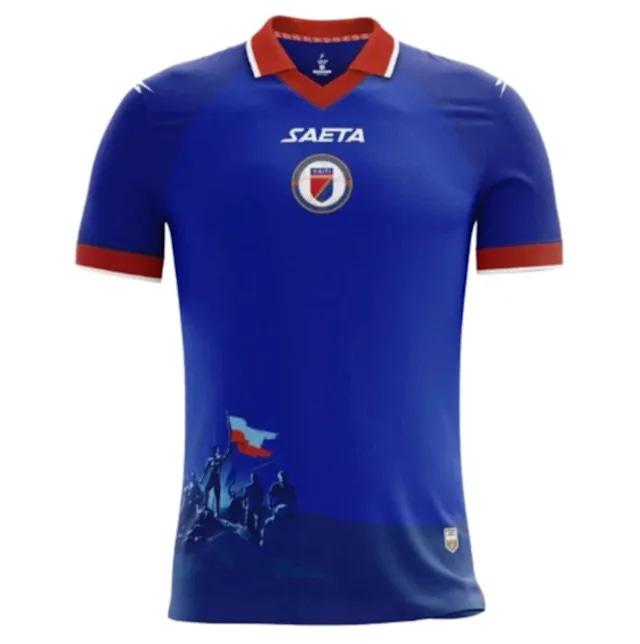
So the uniform was redone. Yes, you can redesign a jersey in 72 hours and call it compliance. What you cannot do is subpoena Konpa.
Rara was resistance before it was a party. Bands moving through the streets, brass and bamboo and improvised percussion, a music born to be played by people who weren’t supposed to be making noise in the first place. The horns that have gone up in Haiti throughout the tournament are the same ancestral racket.
And there was no approval process for it, no FIFA or IOC committee to review it, and no one to find it too political.
Haiti exited after the group stage. They opened with a narrow loss to Scotland, then fell to Brazil - where, as an underdog in front of 68,000 fans mostly there for the Seleção, Haiti still held the five-time champions scoreless in the second half - and by the time they met Morocco in their final match, their fate was already sealed.
Outside of Cape Verde, it would be hard to find a more beloved team in this tournament - not despite the chaos, but because of how they carried it. With a few weeks left, the tournament in some cities is already packing up. Eliminated teams have headed home, many players have returned to their clubs, and the stadiums are quietly taking back their corporate names. But when all of it has been folded away and put in storage, Haiti still won’t have a home to return to - only a jersey light enough for a carry-on. A nation you can carry. Turns out that’s not a metaphor. It’s the only kind the Haitian team has been allowed to be.
More like this

I Love Boosters, Boots Riley, and the Battle of Black Art at the Box Office
Despite their impact, nearly all culturally specific, Black-directed films are produced with budgets below $40 million, but are still expected to compete with…
Xero Gravity · 6 min

Megan Thee Stallion: The Consequences of Being A Sexual Black Woman
After the death of her parents, grandparents, and the shooting by Tory Lanez, Megan Thee Stallion was facing one battle after another. For many Black women,…
Habiba Katsha · 5 min

The Ghost of Madison Square Garden's Past
A 1999 rematch, two franchises that became their cities, and the uncomfortable truth about loving a team that never wins.
Jonathan Giles · 6 min